AVEVA 2026:
AI Makes Its Way into Your SCADA System
With Version 2026, AVEVA is delivering the most significant evolution of its HMI/SCADA solutions in 10 years!
AVEVA is accelerating the modernization of HMI/SCADA systems: AI simplifies the development and use of industrial data, cybersecurity is strengthened, and existing customers can upgrade while protecting their investments.
InTouch, System Platform, and Historian Powered by AI
AVEVA software is evolving
AVEVA InTouch HMI
AVEVA System Platform
AVEVA Historian
What's Actually Changing and Transforming Your Operations

Modernize Your SCADA System Without Starting From Scratch
AVEVA 2026 allows you to upgrade your existing applications while retaining your code, graphics, and configurations. You can gradually modernize your environment without jeopardizing the investments you've already made.

Develop Faster with AI and Improve Usability
New import/export tools, open CSV/XML formats, versioning, and object-oriented structures simplify the creation and evolution of applications. Teams save time, further standardize their projects, and reduce manual tasks.

Access your transactions from anywhere via the Web
The InTouch and OMI applications are now more easily accessible via a web browser, offering both visualization and control capabilities. This allows teams to monitor and manage operations beyond the traditional control room.

Connect your operations to IT, the cloud, and your data

Simplify NIS2 compliance and prepare for the CRA

Leverage Your Data in Natural Language Using LLMs
AVEVA InTouch HMI 2026
Modern and future-proof supervisory software
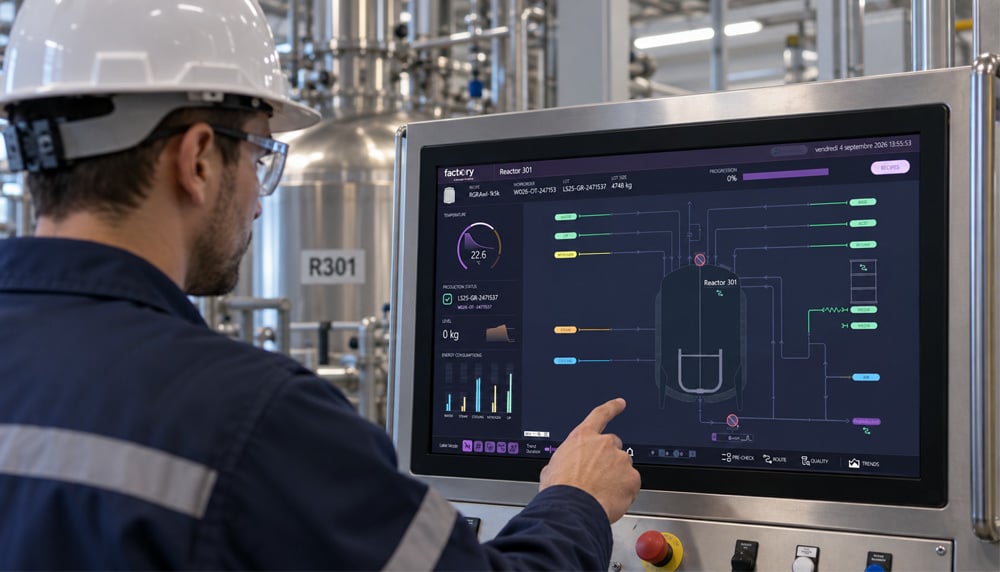
Design your HMI/SCADA system quickly using the latest technologies. For existing customers, InTouch 2026 preserves your applications while offering more web-based capabilities, openness, and flexibility to modernize your monitoring system and ensure compatibility with the latest Microsoft operating systems.
- New Web Client (WPA): monitoring accessible via the web.
- Object-oriented approach: model your equipment as objects.
- Python & C#: Develop advanced, reusable functions.
- OPC UA Import: Integrate your equipment more quickly.
- Industrial Graphics in XML: Simplify modifications, versioning, and AI.
- Cybersecurity & CRA: a more secure and modernized platform.
AVEVA System Platform & OMI 2026
Develop faster, connect more easily, monitor from anywhere
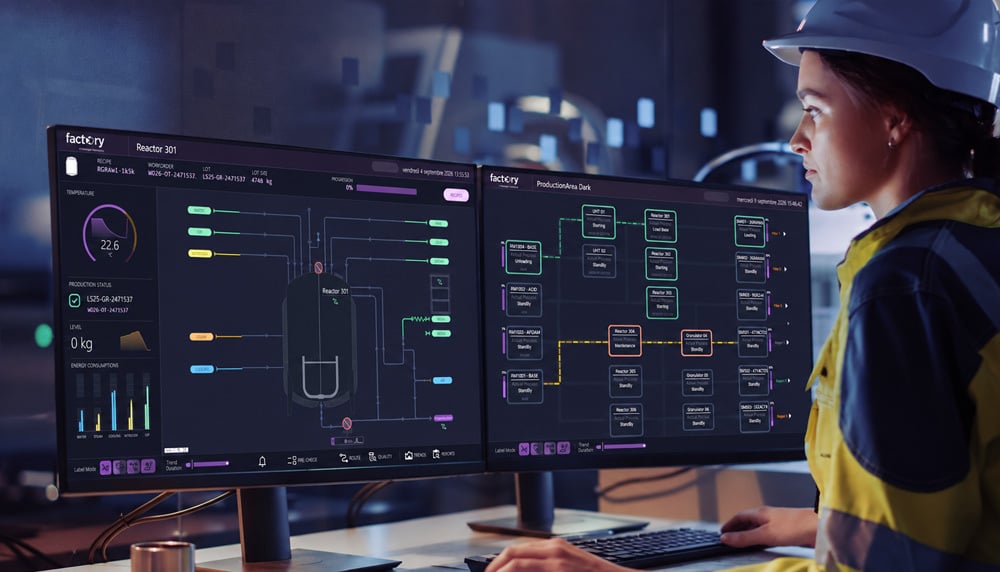
Develop faster, extend your monitoring to IT/OT, and access your operations via the web.
- CSV & XML: Simplified Engineering
- Python & C#: Advanced Development
- OPC UA & MQTT: Automated Configuration
- MQTT & UNS: IT/OT connectivity
- OMI Web: Remote monitoring
- Cybersecurity & CRA: Enhanced Protection
AVEVA Historian 2026
Unlock Your Industrial Data for AI
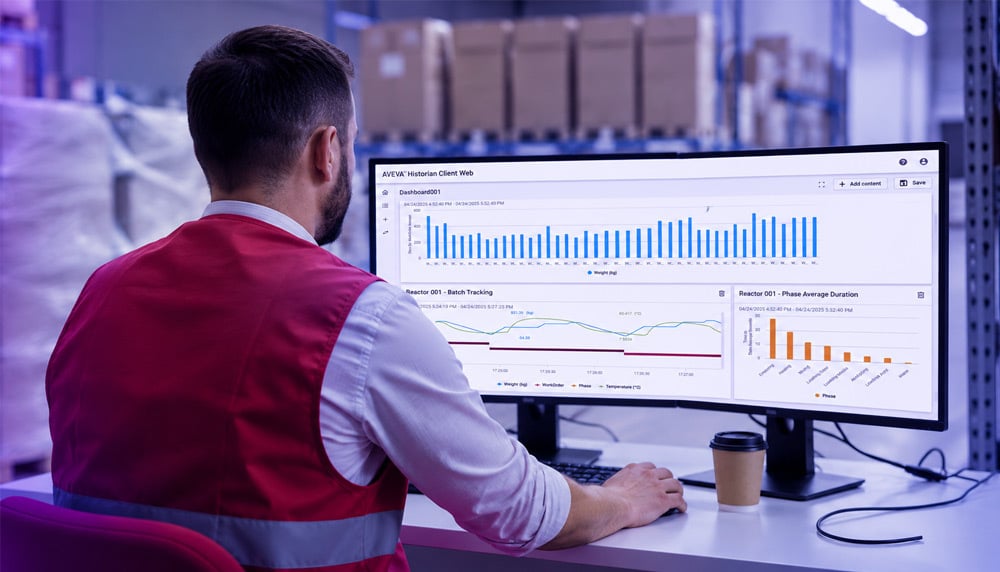
AVEVA Historian 2026 makes it easier to access, share, and analyze production data. With greater openness to IT applications, the web, and new analytical use cases, Historian is becoming an industrial database that is easier to leverage across the entire enterprise.
- Modernized web client to facilitate the analysis of Historian data
- Open web APIs to facilitate integration with IT applications
- Data publication via UNS using more open data models
- Historian Agent for replicating data to CONNECT Data Services
- Integrated MCP server for AI and intelligent data utilization
- Modernized cybersecurity and architecture within the Operations Control 2026 ecosystem
AVEVA 2026: Much More Than Just an Update
| Features | Before 2026 | AVEVA 2026 |
|---|---|---|
| Updating Your Existing Apps | ||
| Web interface with read/write capabilities | ||
| Unified Web Engine between InTouch and OMI | ||
| Server-Side Python & C# Development | ||
| Export objects and graphics in XML and CSV formats | Limited | |
| AI-Assisted Development | ||
| Enhanced Cybersecurity with CRA (Cyber Resilience Act) Support | Limited | |
| Technical diagnostic tools to facilitate application maintenance | ||
| Using GitHub for My Functional and Graphical Objects | ||
Frequently Asked Questions About AVEVA 2026
Why Migrate Your AVEVA Monitoring Application to Version 2026?
The 2026 version of AVEVA InTouch and System Platform software allows you to migrate your current applications while preserving your existing developments.
AVEVA 2026 is more than just a functional update. This new generation evolves the architecture of industrial supervision in five key areas: portfolio consistency, simplification of the application lifecycle, AI-ready engineering, IT/OT convergence, and enhanced cybersecurity. In particular, it offers enhanced web functionality, open CSV/XML configurations, support for the Python and C# programming languages, support for MQTT, SparkPlug, and OPC UA protocols, as well as a modernized architecture to prepare systems for new uses of data and AI.
Factory Software advises manufacturers on the evaluation, migration, and deployment of AVEVA 2026 versions to identify the updates that are truly relevant to their existing supervisory architecture. Our application engineers are here to support you in ensuring the smooth execution of your project by providing guidance and guaranteeing compliance with AVEVA best practices.
Do I need to redevelop my InTouch applications to migrate to AVEVA InTouch HMI 2026?
No. One of the principles of AVEVA’s strategy is precisely to modernize products while preserving existing applications and investments. An existing InTouch application can therefore continue to run after migration without requiring a complete rebuild of the project.
InTouch 2026 then allows you to gradually adopt new capabilities: the new Web Client, Industrial Graphics, more advanced UDT structures, OPC UA, Python/C#, and open XML formats. This approach enables the Factory Software team to support you and advise you on the best technical architecture for modernizing your SCADA system.
Can I access AVEVA InTouch and OMI from a web browser?
Yes. The Web is one of the major new features in the 2026 releases. AVEVA is unifying InTouch Web and OMI Web under a common Web architecture, with access to applications via a browser.
Each InTouch and OMI 2026 runtime includes at least one fully functional Web session with read and write capabilities, even without an additional Web Server license. Packs of 3 or 5 additional Web clients, as well as larger configurations, are also available.
For manufacturers, this makes it possible to extend monitoring beyond the traditional SCADA workstation and provide access to operational information to other authorized users (maintenance, production, etc.), while maintaining a controlled architecture.
What are the main new features in AVEVA System Platform and OMI 2026?
System Platform and OMI 2026 place a particular emphasis on developer productivity, open architectures, and the Web.
Key enhancements include CSV and XML import/export workflows, Python and C# scripting, Auto-Build from OPC UA and MQTT, the publication of System Platform models to MQTT for Unified Namespace architectures, and improvements to OMI Web. Open configuration formats also enable better integration of versioning and the use of generative AI tools to assist with certain engineering tasks.
For engineering teams, the goal is clear: to reduce manual tasks, further standardize projects, and accelerate their development over time.
Does AVEVA 2026 facilitate connectivity between SCADA, IT, the cloud, and industrial data?
Yes. IT/OT integration is one of the five key areas of focus for the 2026 release.
AVEVA is expanding the use of OPC UA, MQTT, Unified Namespace, and Web APIs to make operational data more easily accessible to other systems across the enterprise. In particular, System Platform can publish its model to an MQTT broker, which facilitates the implementation of UNS architectures and the sharing of data between OT, IT, analytics, and cloud systems.
Factory Software can thus support manufacturers not only with SCADA monitoring but also with the architecture needed to circulate and contextualize production data across different systems.
What does AVEVA Historian 2026 offer for industrial data utilization?
The evolution of AVEVA Historian is part of a strategy aimed at making industrial data more accessible and easier to leverage via the web, IT applications, new analytics tools, and LLM AI tools. The goal is to enable you to access your Historian data using natural language through Copilot, Claude, ChatGPT, and other tools.
AVEVA is now prioritizing the Historian Web Client experience: the legacy Historian client is no longer available in version 2026, and future investments are focused on the modern web experience.
Historian also exposes its data via web APIs, making it easier for third-party systems to consume it. At the same time, the architecture is being designed to support the use of AI agents capable of analyzing data and alarms, identifying correlations, and helping to generate dashboards. However, some of these AI features are being introduced as additional modules that will be rolled out gradually around version 2026.
How does AVEVA 2026 use artificial intelligence in industrial applications?
The contribution of AI in 2026 will primarily involve data engineering and data utilization.
New data export features in CSV and XML file formats can be used with generative AI tools to assist in the creation or modification of templates, configurations, or Industrial Graphics. Python and C# also open up the possibility of integrating more advanced processing into applications. AVEVA describes this evolution as a foundation for moving from manual, screen-by-screen modifications to more automated and governed development methods.
Regarding Historian, AVEVA is also preparing integrations with AI agents and an MCP that will enable more direct querying of industrial data. However, it is important to distinguish between the features included in version 2026 and the additional AI capabilities planned for the roadmap.
Does AVEVA 2026 truly improve the cybersecurity of SCADA systems and help prepare for the Cyber Resilience Act?
Yes. Cybersecurity is one of the key focus areas of the 2026 release. AVEVA is modernizing several legacy components and strengthening security by default: improved credential management, reduced administrator privileges, secured application folders, restrictions on certain external components, and a reduced attack surface.
The removal of DCOM in favor of more modern technologies such as gRPC also reduces the number of ports required and modernizes communications. Support for the .NET Roll Forward also simplifies keeping Microsoft components up to date without necessarily having to wait for a new version of AVEVA software.
AVEVA states that these changes are intended to prepare its products for the requirements of the Cyber Resilience Act (CRA). It is more accurate to speak of preparation and alignment with CRA requirements rather than assuming that a simple software upgrade is sufficient to bring an entire industrial facility into compliance.
Factory Software, a distributor and expert in AVEVA solutions, can help you assess your HMI/SCADA architecture, prepare for your migration to AVEVA 2026, and identify new features relevant to your operations.
Is it possible to use GitHub to manage changes to my objects and charts?
Yes. The new export features for CSV and XML formats allow you to use GitHub to manage the components of your industrial monitoring application.